Rotational
Legged Locomotion
The Rotopod
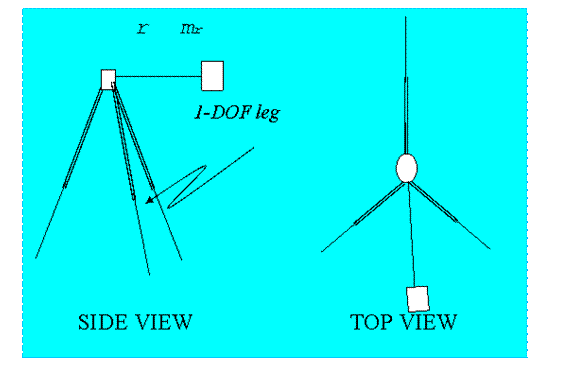 What is it?
o
The Rotopod is a
novel robot mechanism which combines the features of wheeled and legged
locomotion in an unusual way.
o
This robot has the
advantage of legged locomotion in stepping its 1-DOF legs over objects, but its
drive mechanism is a rotating reaction mass that rotates the robot, in a
controllable fashion, around each of its legs, similar to a rotating wheel.
o
The mechanism has
the potential to transfer the energy from the rotating reaction mass in an
efficient manner to the legs, effecting a spinning forward motion
o
One of the
inspirations for the Rotopod Design was the tripedal “spider”
creature described in Arthur Clark’s novel Rendezvous with Rama (p.185 of the 1974 Pan books edition).
o
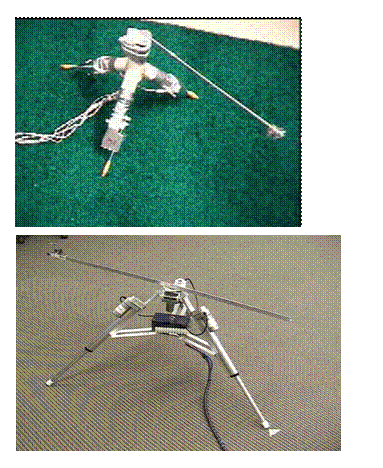
The picture to
the left shows our first prototype Rotopod. It uses 1DOF rotational
“knee” joins on each leg in contrast to the 1DOF translational
joints shown in the figure above. This was cheaper and easier to build but
makes stepping more difficult to control.
o
Control is
offboard in this prototype. An onboard controller would be carried on a
triangular platform between the legs just below where they join.
How does a Rotopod Move?
o
The Rotopod moves
by rotating around each of its legs in turn.
o
A rotation of q radians around a leg is call a step, and it results in the center of the robot moving a distance
o
A regular
sequence of steps is called a gait.
o
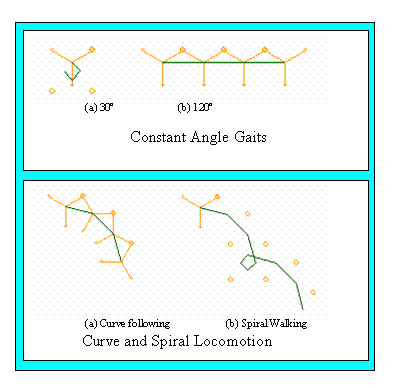
The robot can produce
a broad set of gaits: stepping for various values of q on one leg, or any sequence of legs
o
One of the most
interesting gaits is spiral walking. This
is a very natural behavior for the rotopod mechanism. The final result looks a
little like a prolate cycloid. It
leads to paths that have a width
element as well as a length (i.e. a
fractal dimension) and hence may be very efficient for covering space (e.g.,
searching, surveillance, exploring, etc.)
o
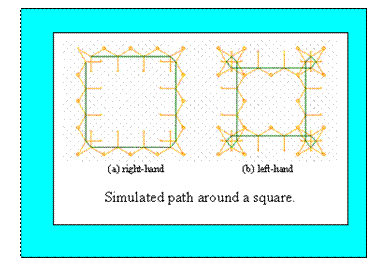 Sharp turns are not necessarily a problem for a rotopod,
since its continual rotation allows it to change direction dramatically under
certain conditions.
Sharp turns are not necessarily a problem for a rotopod,
since its continual rotation allows it to change direction dramatically under
certain conditions.
o
The diagram to
the right shows a rotopod traversing a square traveling clockwise and then
counterclockwise.
Some example videos
ODE simulation
video 1 – continuously moving
ODE Simulation
video 2 – large but discontinuous steps
How does
Stepping Happen?
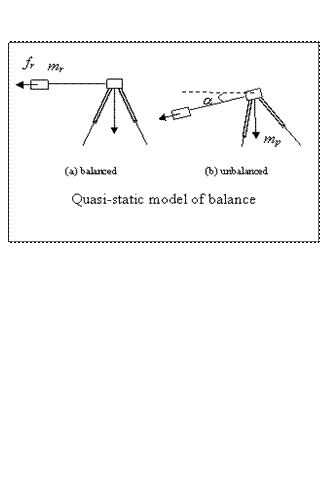
o
The rotopod steps
by shortening the length of one leg.
o
When the reaction
mass traverses that leg, it lifts the other two legs off the ground
momentarily.
o
Without a reaction
torque, the whole body rotates.
o
When the reaction
mass sufficiently clears the leg,(assumes friction in the reaction joint), the
leg is raised again, the suspended legs drop back to the ground and reestablish
a reaction torque
Why is it Efficient?
o
The only purpose
of the leg joints on the rotopod are to raise and lower the body to cause timed
unbalance.
o
The movement of
the body itself is powered by the rotating reaction mass, essentially a
flywheel, storing energy that is converted to motion by the sequenced raising
and lowering of legs.
o
In its most
efficient form, the rotopod is essentially a “virtual” wheel, the
legs acting as spokes.
References
[1]. Rotational Legged
Locomotion. Lyons, D., and Pamnany, K., IEEE Int. Conf. on Advanced Robotics,
[2]. Analysis of Gaits for a
Rotating Tripedal Robot.
[3]. Energy Efficient
Searching using� Rotational Legged
Locomotion. K. Pamnany, MS Thesis.
May 2005.